
S&K Blog
Fall Commercial Property Maintenance Checklist: 5 Things Every Property Manager Should Inspect
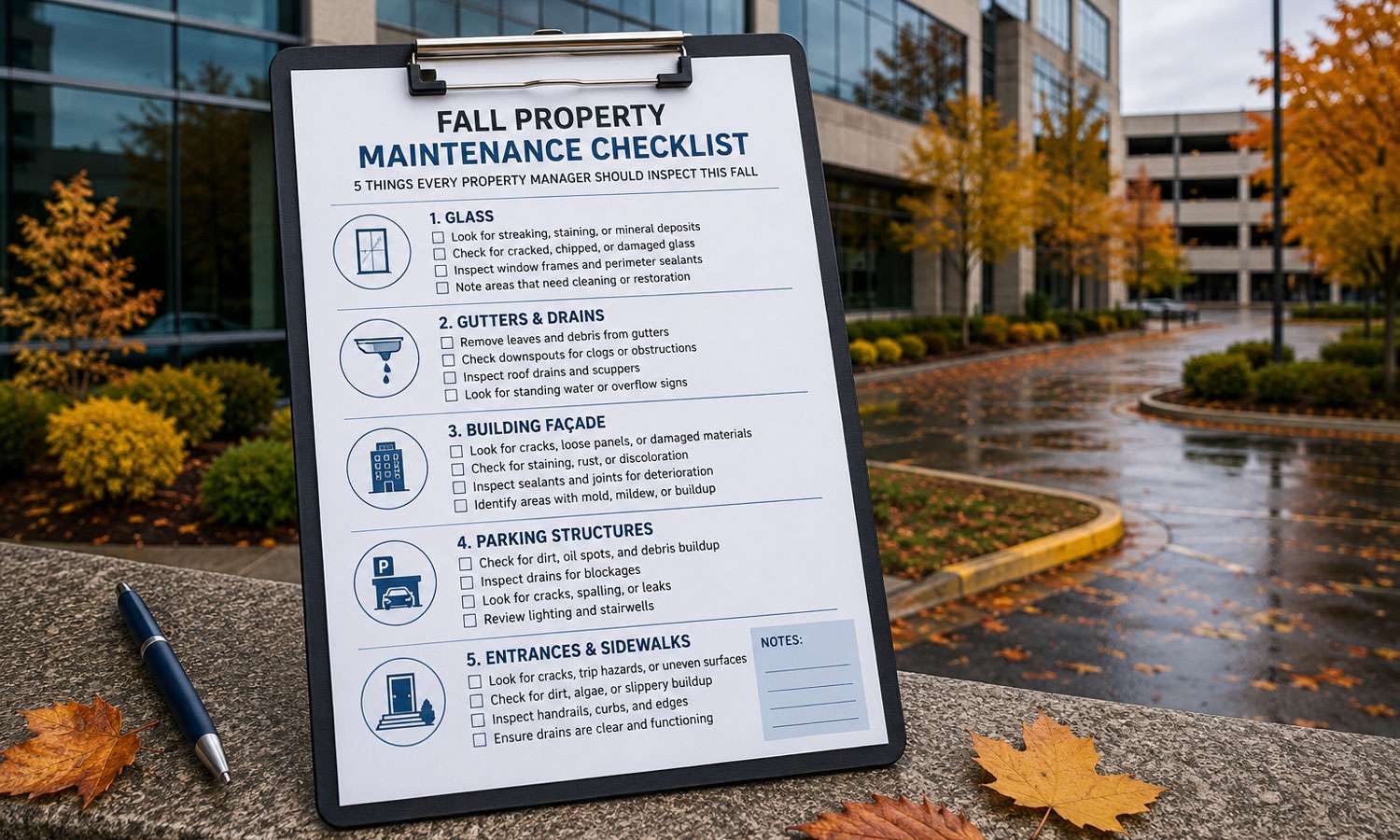
Fall is one of the most important times of year to take a closer look at your commercial property.
Summer weather can leave behind dirt, staining, clogged drainage areas, and other exterior maintenance concerns. At the same time, falling leaves, colder temperatures, rain, and eventually snow and ice introduce a new set of challenges.
A thorough fall commercial property maintenance checklist can help property managers identify issues while there is still time to address them before winter.
You don’t need to turn the inspection into a major project.
Start with five areas: glass, gutters and drains, the building façade, parking structures, and entrances and sidewalks.
Walk the property. Document what you see. Take photos of anything unusual. Then determine what needs attention now, what can be scheduled, and what should simply be monitored.
1. Inspect Exterior Glass and Window Systems
Commercial glass is one of the most visible parts of a property, making changes in its condition relatively easy to spot—if someone is looking for them.
Don’t limit your inspection to whether the windows look dirty.
Walk around the building and look for staining, mineral deposits, oxidation runoff, damaged components, deteriorating perimeter conditions, or other unusual changes.
Fall Glass Inspection Checklist
- Look for hard water or mineral deposits on exterior glass.
- Check for staining beneath metal components or façade materials.
- Identify windows with unusual streaking or discoloration.
- Look for visible chips, cracks, or damaged glass.
- Review window frames and surrounding areas for visible deterioration.
- Check perimeter sealants for obvious cracking, gaps, or separation.
- Note areas where water appears to collect or repeatedly run across the glass.
- Document glass that doesn’t improve with routine cleaning.
Some exterior glass conditions are primarily cosmetic. Others may warrant closer attention.
For example, routine dirt may be addressed through commercial window cleaning, while hard water deposits, mineral buildup, oxidation runoff, or other stubborn staining may require glass restoration.
Identifying the difference early can help property managers plan the appropriate maintenance instead of waiting until the condition becomes more difficult to address.
2. Check Gutters, Roof Drains and Exterior Drainage
Fall and drainage go hand in hand.
Leaves, seed pods, dirt, branches, and other debris can accumulate in gutters and drainage areas just as seasonal rainfall increases.
Then temperatures begin to fall.
Water that isn’t draining properly can collect in unwanted areas, and freezing temperatures can create additional problems.
Fall Gutter and Drainage Checklist
- Check gutters for leaves, dirt, and visible debris.
- Inspect downspouts for obvious blockages.
- Review roof drains and scuppers where safely accessible.
- Look for standing water near drainage areas.
- Check exterior drains around entrances and pedestrian areas.
- Inspect drainage in and around parking structures.
- Look for water stains that may indicate recurring overflow.
- Note areas where water regularly collects after rainfall.
- Make sure drainage paths direct water away from critical areas.
Pay particular attention to patterns.
A single puddle following a heavy storm may not indicate a significant problem. Water that repeatedly collects in the same location is worth documenting and investigating.
The goal is to make sure water has a clear path away from areas where accumulation could contribute to deterioration or become a winter safety concern.
3. Walk the Building Façade
A building façade doesn’t have to look damaged to benefit from inspection.
Exterior materials are continually exposed to rain, UV radiation, wind, temperature changes, pollution, biological growth, and other environmental conditions.
Fall provides an opportunity to establish the current condition of those surfaces before winter.
Fall Building Façade Checklist
- Look for new or worsening cracks.
- Identify loose or visibly displaced panels or components.
- Check for staining or discoloration.
- Look for biological growth or heavy surface buildup.
- Review visible joints and sealants for deterioration.
- Check areas around windows and transitions between materials.
- Look for rust or oxidation staining.
- Inspect ledges and horizontal surfaces where debris collects.
- Compare problem areas with photos or documentation from previous inspections.
- Document anything that appears to have changed.
Don’t assume every stain or crack represents a structural problem. The purpose of a routine property walk is to identify changes and determine what deserves further evaluation.
Photography can be particularly useful here.
Take pictures from consistent locations and angles. Over time, those images can help property teams determine whether a condition is stable or changing.
For multi-story buildings, ground-level observations also have limitations. Conditions higher on the façade may only become visible during professional exterior maintenance or specialized building-envelope inspections.
4. Inspect Parking Garages and Parking Structures
Parking structures are easy to overlook because they are designed to handle heavy use.
That heavy use is precisely why they deserve regular attention.
Vehicles continually introduce dirt, oil, road debris, tire residue, moisture, and seasonal contaminants into parking garages. During winter, road salt and deicing materials can add to that buildup.
Fall is a good time to assess the garage before another winter begins.
Fall Parking Structure Checklist
- Look for accumulated dirt and debris in traffic areas.
- Check corners and low-traffic areas for buildup.
- Inspect drains for debris or obstructions.
- Look for standing water or evidence of poor drainage.
- Check stairwells and pedestrian areas.
- Inspect entrances and exits for heavy staining.
- Look for oil spots or other surface contamination.
- Review walls, columns, and overhead surfaces for visible buildup.
- Check lighting areas for accumulated dirt or debris.
- Document visible cracks, spalling, leaks, or other conditions that may require evaluation by the appropriate professional.
Cleaning and inspection should be treated as separate but complementary activities.
Parking garage cleaning removes accumulated dirt and contaminants, while regular property inspections can help management teams identify conditions that may require maintenance or specialized evaluation.
5. Inspect Entrances, Sidewalks and High-Traffic Exterior Areas
Your building entrance may cover a relatively small portion of the property, but it handles a disproportionate amount of traffic.
Employees, tenants, customers, residents, vendors, and visitors may all pass through the same areas every day.
Fall is a good time to evaluate those surfaces before leaves, rain, snow, and ice make exterior conditions more challenging.
Fall Entrance and Sidewalk Checklist
- Look for dirt, algae, mildew, or other surface buildup.
- Check sidewalks for staining and heavily soiled areas.
- Inspect entryways for accumulated debris.
- Look for areas where water collects.
- Check nearby drains for obstructions.
- Review steps, ramps, and landings.
- Inspect curbs and transitions between walking surfaces.
- Check awnings and overhangs for visible buildup.
- Look at exterior glass and doors around the entrance.
- Identify areas likely to become problematic when covered by leaves, snow, or ice.
Clean surfaces also make it easier to see the actual condition of the material underneath.
Depending on the surface, commercial pressure washing or soft washing can remove accumulated dirt and organic buildup while improving the overall appearance of high-visibility areas.
Don’t Just Inspect—Document
Walking the property is useful.
Creating a record of what you find is better.
Property managers don’t necessarily need sophisticated inspection software to establish a useful maintenance history. A simple process can provide valuable information over time.
For each concern, record:
- Property or building
- Exact location
- Date observed
- Photo
- Description
- Immediate action required, if any
- Recommended follow-up
- Date to review again
This is particularly helpful for conditions that don’t require immediate action.
Instead of relying on memory, you can compare photos and notes during the next property walk and determine whether something has changed.
Sort Your Findings Into Four Categories
Once you’ve completed the inspection, don’t treat every observation as equally urgent.
Sort your findings into four categories.
Address Now
Issues that require prompt attention or professional evaluation.
Schedule This Fall
Routine cleaning, maintenance, or other work that would ideally be completed before winter.
Monitor
Conditions that don’t currently require action but should be documented and reviewed during future inspections.
Budget for Later
Larger maintenance or restoration projects that may need to be incorporated into future operating or capital budgets.
This simple step turns a property walk into a useful maintenance planning tool.
Use Your Fall Inspection to Plan for Winter—and Next Year
A fall inspection isn’t only about preparing for colder weather.
It can also provide useful information for next year’s maintenance budget.
If your windows require cleaning more frequently than expected, adjust the schedule.
If a parking garage has substantial seasonal buildup, plan its next cleaning in advance.
If the same façade staining continues to return, determine whether further evaluation is appropriate.
If drainage areas repeatedly require attention, incorporate them into a recurring inspection schedule.
The objective is to move away from:
“What needs to be fixed today?”
and toward:
“What does this property need over the next 12 months?”
That’s the foundation of more proactive commercial property maintenance.
Supporting Commercial Properties Nationwide
S&K Building Services provides professional exterior building maintenance services across a growing network of markets throughout the United States.
From individual commercial properties to multi-location portfolios, we help property and facility management teams coordinate exterior cleaning and maintenance while maintaining consistent service standards across locations.
Our service areas include:
- Atlanta, GA
- Chicago, IL
- Cincinnati, OH
- Cleveland, OH
- Denver, CO
- Detroit, MI
- Finger Lakes, NY
- Grand Rapids, MI
- Indianapolis, IN
- Lansing, MI
- Louisville, KY
- Madison, WI
- Milwaukee, WI
- Nashville, TN
- New Orleans, LA
- Phoenix, AZ
- Portsmouth, OH
- Rochester, NY
- St. Louis, MO
- West Palm Beach, FL
Turn Your Fall Inspection Into a Maintenance Plan
A good fall property inspection isn’t about finding something to spend money on.
It’s about knowing the condition of your property.
Walk the building. Check the glass. Look at the drainage. Inspect the façade. Walk the parking structure. Pay attention to entrances and sidewalks.
Document what you find and prioritize what actually needs attention.
If your inspection identifies exterior cleaning or maintenance needs, S&K Building Services can help determine the appropriate next steps for a single property or a multi-location portfolio.
Complete your fall property inspection now—before winter conditions make small maintenance concerns harder to address.
Find Something That Needs Attention?
If your fall property inspection identifies exterior cleaning or maintenance needs, S&K Building Services can help.
- Commercial window cleaning
- Building & façade cleaning
- Parking structure cleaning
- Multi-location portfolio support
Tell us about your property to get started.
Frequently Asked Questions About Fall Commercial Property Maintenance
A fall commercial property inspection should include exterior glass and window systems, gutters and drainage areas, the building façade, parking structures, entrances, sidewalks, and other high-traffic exterior areas. Property managers should document visible changes and determine which items require immediate attention, scheduled maintenance, monitoring, or future budgeting.
Ideally, exterior property inspections should take place early enough in the fall to allow time for appropriate maintenance before colder temperatures, snow, and ice arrive. The exact timing will depend on the property’s climate and location.
Leaves and seasonal debris can obstruct gutters, roof drains, downspouts, and exterior drainage areas. Inspecting and clearing these areas can help water move away from the building before freezing temperatures arrive.
Take dated photographs and record the location and description of each condition. Note whether it requires immediate action, scheduled maintenance, monitoring, or future budgeting. Repeating this process during future inspections makes it easier to identify changes over time.
Needs vary by property, but common fall priorities include commercial window cleaning, gutter and drainage cleaning, pressure washing or soft washing, parking garage cleaning, façade cleaning, and addressing visible exterior maintenance concerns before winter conditions arrive.
Yes. S&K Building Services provides commercial window cleaning, pressure washing, soft washing, façade cleaning, parking garage cleaning, glass and metal restoration, roof anchor inspection, and other specialty exterior building services. The appropriate service will depend on the property and condition identified.
Commercial building exteriors should be inspected regularly throughout the year, with additional attention during seasonal transitions and after severe weather. Spring and fall inspections are especially useful for identifying maintenance needs before summer heat or winter weather.
Common warning signs include stained or cloudy glass, clogged drains, façade discoloration, deteriorating sealants, loose exterior components, standing water, biological growth, and heavy buildup on sidewalks, entrances, or parking structures.
Yes. After severe storms, high winds, heavy rain, snow, or ice, property managers should look for visible changes to the building exterior, drainage problems, loose materials, water intrusion, and other new conditions. Concerns involving structural or building-envelope components should be evaluated by an appropriately qualified professional.
Ready to Get Started?
S&K is ready to get to work for you! A member of our team is available to discuss your needs and deliver a timely estimate of services.
Contact Us