
S&K Blog
Commercial Building Maintenance Planning: How to Avoid Budget Surprises
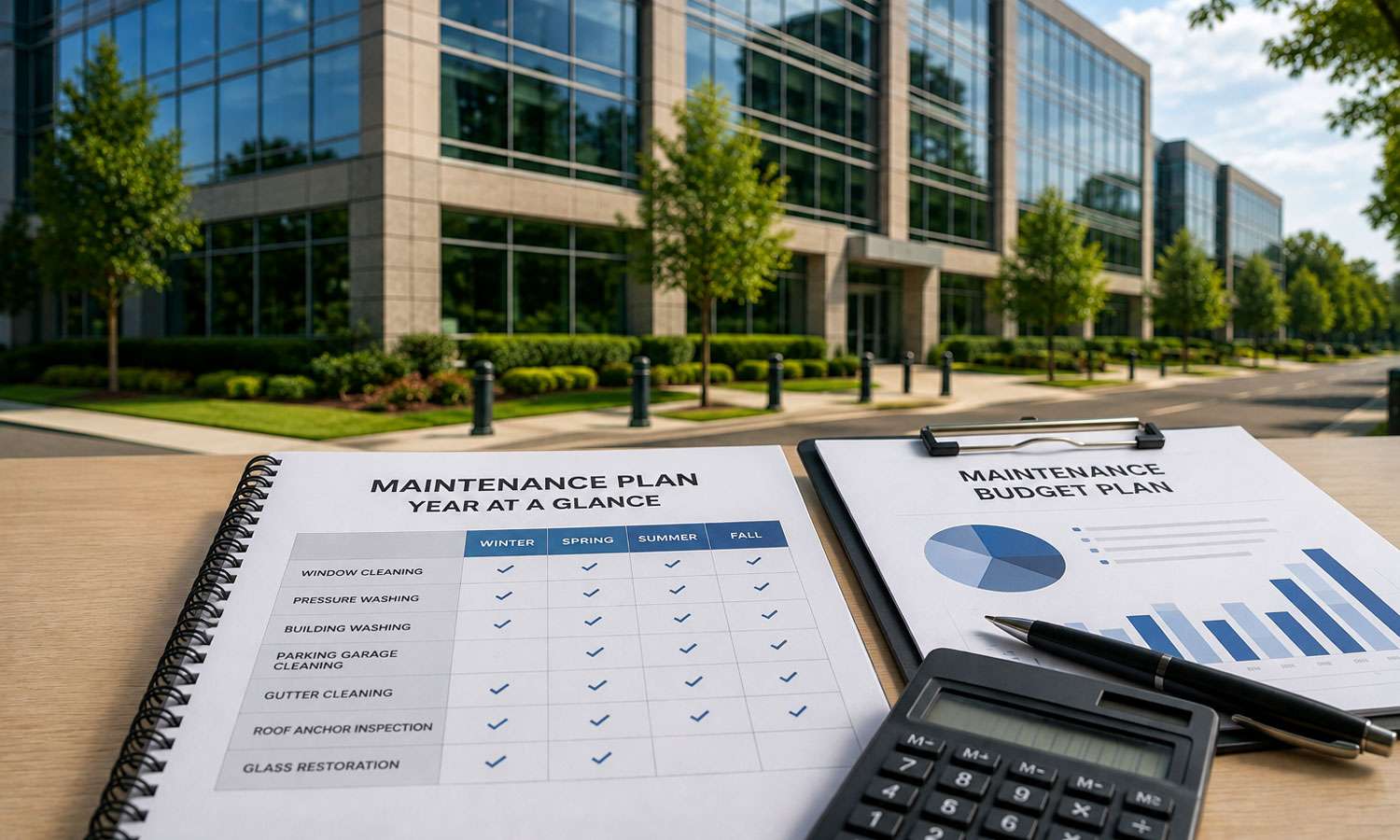
Unexpected maintenance expenses can disrupt even a carefully planned facility budget.
An urgent exterior cleaning project. Glass that now requires restoration instead of routine cleaning. Deferred maintenance that suddenly can’t wait. Multiple properties requiring service at the same time.
Individually, these expenses may be manageable. When several appear unexpectedly—or late in the budget year—they can create significant challenges for property and facility teams.
That’s why commercial building maintenance planning should be proactive rather than reactive.
A planned approach to exterior maintenance can help property managers anticipate recurring needs, prioritize projects, coordinate service across multiple locations, and make better use of annual maintenance budgets.
Your maintenance budget may never be completely predictable.
But it shouldn’t be full of surprises.
Why Reactive Commercial Building Maintenance Can Cost More
When maintenance is postponed until a problem becomes urgent, property teams lose some of their ability to control when and how the issue is addressed.
Instead of scheduling work during an appropriate maintenance window, the project may need to be completed quickly.
Instead of incorporating the expense into an annual budget, funds may need to be found unexpectedly.
And instead of addressing a condition through routine maintenance, prolonged exposure or buildup may require more extensive service.
Consider exterior glass.
Routine commercial window cleaning helps remove dirt and environmental buildup from glass. If certain mineral deposits, hard water stains, oxidation runoff, or other contaminants remain on the surface for extended periods, routine cleaning may eventually be insufficient.
At that point, glass restoration may be needed.
The same principle can apply throughout a commercial property’s exterior: addressing maintenance needs early often gives facility teams more options than waiting until conditions worsen.
Planned Maintenance Creates More Predictable Budgets
One of the biggest advantages of preventative maintenance is visibility.
When property managers understand what needs to be serviced, how frequently it should be addressed, and which projects may be coming in the months ahead, they can make more informed financial decisions.
A commercial exterior maintenance plan can help identify:
- Recurring services
- Seasonal maintenance needs
- Properties requiring additional attention
- Projects that can be grouped together
- Conditions that should be monitored
- Potential restoration needs
- Future maintenance priorities
That information allows facility teams to look beyond the next service call and develop a broader maintenance strategy.
Move From “What Broke?” to “What’s Next?”
Reactive maintenance asks:
What needs to be fixed right now?
Proactive maintenance asks:
What will this property need next month, next quarter, and next year?
That distinction can make a significant difference when managing a commercial property budget.
Rather than responding to individual maintenance requests as they arise, property managers can create a schedule that accounts for predictable services throughout the year.
Build an Annual Commercial Exterior Maintenance Schedule
Many exterior building services are naturally recurring or seasonal.
Commercial window cleaning may be scheduled at regular intervals. Parking structures may require periodic cleaning. Building washing may be appropriate at particular times of year. Gutters and drainage areas may require attention before seasonal weather changes.
Other services may be less frequent but still predictable with proper planning.
Depending on the property, an annual commercial building maintenance schedule might include:
Commercial Window Cleaning
Regular window cleaning helps maintain the appearance of the property and prevents routine dirt and environmental contaminants from accumulating unchecked.
Service frequency can vary considerably depending on the property type, building location, tenant expectations, environmental exposure, and appearance standards.
Pressure Washing and Soft Washing
Exterior surfaces, sidewalks, entryways, façades, loading areas, and other portions of a commercial property can accumulate dirt, organic growth, pollution, and staining.
Scheduling exterior washing proactively allows these projects to become part of the maintenance calendar instead of being requested only when buildup becomes highly visible.
Parking Garage Cleaning
Parking structures collect dirt, oil, road residue, debris, and seasonal contaminants throughout the year.
Planned garage cleaning can help maintain the appearance and condition of these heavily used areas while allowing property teams to schedule work around tenants, employees, customers, and traffic patterns.
Glass and Metal Restoration
Restoration shouldn’t necessarily be treated as a recurring cleaning service, but identifying developing conditions early can help property teams determine when specialized attention may be needed.
An evaluation can also help distinguish between surfaces that need routine cleaning and those that may benefit from restoration.
Roof Anchor Inspections
Buildings utilizing permanent roof anchors or façade access systems may require periodic inspection and certification.
Including these requirements in the maintenance calendar helps facility teams avoid discovering an expired or overdue inspection when exterior work is already being scheduled.
Seasonal Exterior Maintenance
Seasonal changes can create different maintenance priorities throughout the year.
Spring may reveal winter buildup. Summer can provide favorable conditions for larger exterior projects. Fall is an important time to address drainage and prepare building exteriors for colder weather.
Planning around these cycles helps turn seasonal maintenance into a predictable process.
Multi-Property Maintenance Planning Creates Additional Challenges
Managing one commercial property requires coordination.
Managing ten, twenty, fifty, or more locations introduces another level of complexity.
Each property may have different:
- Building materials
- Service histories
- Cleaning frequencies
- Access requirements
- Tenant expectations
- Seasonal conditions
- Budgets
- Local contacts
- Maintenance priorities
Without a coordinated strategy, multi-property maintenance can become fragmented.
One location schedules window cleaning in spring. Another waits until fall. A third calls only when tenants complain. Another discovers a restoration issue during budget season.
The result can be inconsistent property standards and unpredictable spending.
Create Consistency Across a Commercial Property Portfolio
For property management groups overseeing multiple buildings, a portfolio-level maintenance strategy can provide a clearer view of what is happening across all locations.
Instead of managing each property entirely independently, teams can establish common service standards while still accounting for the needs of individual buildings.
A multi-property maintenance plan can help answer questions such as:
Which properties need service this quarter?
Which services should occur at every location?
Which buildings require more frequent maintenance?
Are there exterior conditions that need to be budgeted for next year?
Can projects be scheduled earlier to avoid a year-end rush?
This becomes particularly valuable for regional and national portfolios where multiple facility teams, property managers, vendors, and budgets may be involved.
Avoid the Year-End Maintenance Spending Spike
A common challenge in commercial property management is discovering late in the year that multiple maintenance projects still need to be completed.
Some may have been deferred.
Others may have been overlooked.
And some may suddenly become priorities as budgets are reviewed or winter approaches.
The result is a year-end rush to schedule projects, allocate remaining funds, and complete work within increasingly limited weather and scheduling windows.
A better approach is to review exterior maintenance needs throughout the year.
For example, property teams can divide maintenance planning into quarterly reviews:
Q1: Assess
Review property conditions, previous service history, recurring needs, and annual priorities.
Q2: Execute
Complete appropriate spring and early-summer cleaning and maintenance projects.
Q3: Prepare
Address exterior conditions, drainage, glass, façades, and other needs before colder weather.
Q4: Evaluate
Review completed work, identify remaining priorities, and begin planning the following year’s maintenance budget.
This doesn’t mean every property requires every service every quarter.
It means maintenance decisions become intentional rather than reactive.
Preventative Maintenance Supports Capital Planning, Too
Routine maintenance planning can also provide useful information for longer-term capital planning.
When exterior conditions are regularly observed and documented, property teams are better positioned to identify patterns.
Is staining repeatedly appearing in the same location?
Are certain areas of glass developing mineral deposits faster than others?
Does a particular façade require more frequent cleaning?
Are there exterior components that should receive specialized evaluation?
These observations can help distinguish a routine maintenance expense from an emerging capital concern.
That gives decision-makers more time to evaluate options and budget accordingly.
What Should Be Included in a Commercial Exterior Maintenance Plan?
An effective plan doesn’t need to be complicated.
It should provide enough structure to answer four basic questions:
What needs to be maintained?
Identify exterior surfaces, glass, access systems, parking structures, drainage areas, and other components requiring regular attention.
How often does it need service?
Establish appropriate cleaning, inspection, or maintenance intervals based on the property.
When should the work occur?
Consider weather, tenant activity, property operations, seasonal conditions, and budgeting cycles.
What needs to be monitored?
Document conditions that don’t require immediate action but should be reviewed during future service visits.
The result is a maintenance roadmap rather than a collection of individual service calls.
Supporting Commercial Properties Nationwide
S&K Building Services provides professional commercial exterior maintenance services across a growing network of markets throughout the United States.
From individual commercial buildings to multi-location property portfolios, our teams help facility and property management professionals coordinate recurring exterior maintenance while maintaining consistent service and communication standards.
Our service areas include:
- Atlanta, GA
- Chicago, IL
- Cincinnati, OH
- Cleveland, OH
- Denver, CO
- Detroit, MI
- Finger Lakes, NY
- Grand Rapids, MI
- Indianapolis, IN
- Lansing, MI
- Louisville, KY
- Madison, WI
- Milwaukee, WI
- Nashville, TN
- New Orleans, LA
- Phoenix, AZ
- Portsmouth, OH
- Rochester, NY
- St. Louis, MO
- West Palm Beach, FL
With local teams operating throughout these markets, S&K Building Services can help simplify exterior maintenance planning for both individual properties and larger commercial portfolios.
Your Maintenance Budget Shouldn’t Be Full of Surprises
Emergency and last-minute maintenance can disrupt schedules, operations, and budgets.
A proactive approach gives commercial property teams greater visibility into what needs attention today, what can be scheduled later, and what should be considered in future budgets.
S&K Building Services provides commercial window cleaning, high-rise window cleaning, pressure washing, soft washing, façade cleaning, parking garage cleaning, glass and metal restoration, roof anchor inspection, and specialty exterior maintenance services for commercial properties across the United States.
Whether you manage one building or a multi-location portfolio, we can help you develop a more organized approach to exterior maintenance.
Talk with S&K Building Services about your properties, current maintenance needs, and upcoming priorities. We’ll help you determine which exterior services should be addressed now and which can be incorporated into your ongoing maintenance plan.
Build Your Exterior Maintenance Plan
Take the guesswork out of commercial exterior maintenance. S&K Building Services can help you plan upcoming services around your properties, priorities, and budget.
- Planned & recurring maintenance
- Professional W-2 crews
- Multi-location portfolio support
- Nationwide service capabilities
Tell us about your properties to get started.
Frequently Asked Questions About Commercial Building Maintenance Planning
Commercial building maintenance planning is the process of identifying recurring and anticipated maintenance needs and scheduling them proactively. For exterior maintenance, this may include commercial window cleaning, building washing, pressure washing, parking garage cleaning, glass or metal restoration, roof anchor inspections, and other property-specific services.
Preventative maintenance gives facility teams greater visibility into upcoming service needs. Rather than waiting for maintenance issues to become urgent, property managers can prioritize projects, schedule recurring services, monitor developing concerns, and allocate funds throughout the year.
There is no single schedule that works for every commercial building. Frequency depends on the property’s location, building materials, environmental exposure, appearance standards, usage, service history, and other factors. A maintenance assessment can help establish appropriate intervals for individual services.
Start by documenting each property’s recurring services, maintenance history, exterior conditions, service frequency, and upcoming needs. Properties can then be grouped into an annual or quarterly schedule while allowing for building-specific requirements.
Depending on the property, exterior maintenance budgets may include commercial window cleaning, high-rise window cleaning, pressure washing, soft washing, façade cleaning, parking garage cleaning, glass and metal restoration, roof anchor inspections, and specialty exterior cleaning and maintenance.
Yes. S&K Building Services works across a growing network of U.S. markets and can support both individual commercial properties and multi-location portfolios. This can help property management teams create greater consistency in scheduling, communication, and exterior maintenance standards across locations.
Planned maintenance can often be more cost-effective because property managers have greater control over scheduling, budgeting, and prioritization. Addressing exterior maintenance needs early may also help prevent conditions from progressing to the point where more extensive cleaning, restoration, or repairs are required.
Ideally, maintenance planning should be an ongoing process rather than a once-a-year exercise. Reviewing exterior maintenance needs throughout the year allows property managers to identify recurring services, developing concerns, and larger projects early enough to incorporate them into the following year’s budget.
Preventative maintenance is scheduled proactively to maintain a property and address concerns before they become urgent. Reactive maintenance occurs in response to an immediate problem or service need. A preventative approach can provide more predictable scheduling and budgeting while reducing reliance on last-minute maintenance.
Ready to Get Started?
S&K is ready to get to work for you! A member of our team is available to discuss your needs and deliver a timely estimate of services.
Contact Us