
S&K Blog
Commercial Building Exterior Maintenance: When Deferred Cleaning Becomes a Bigger Problem
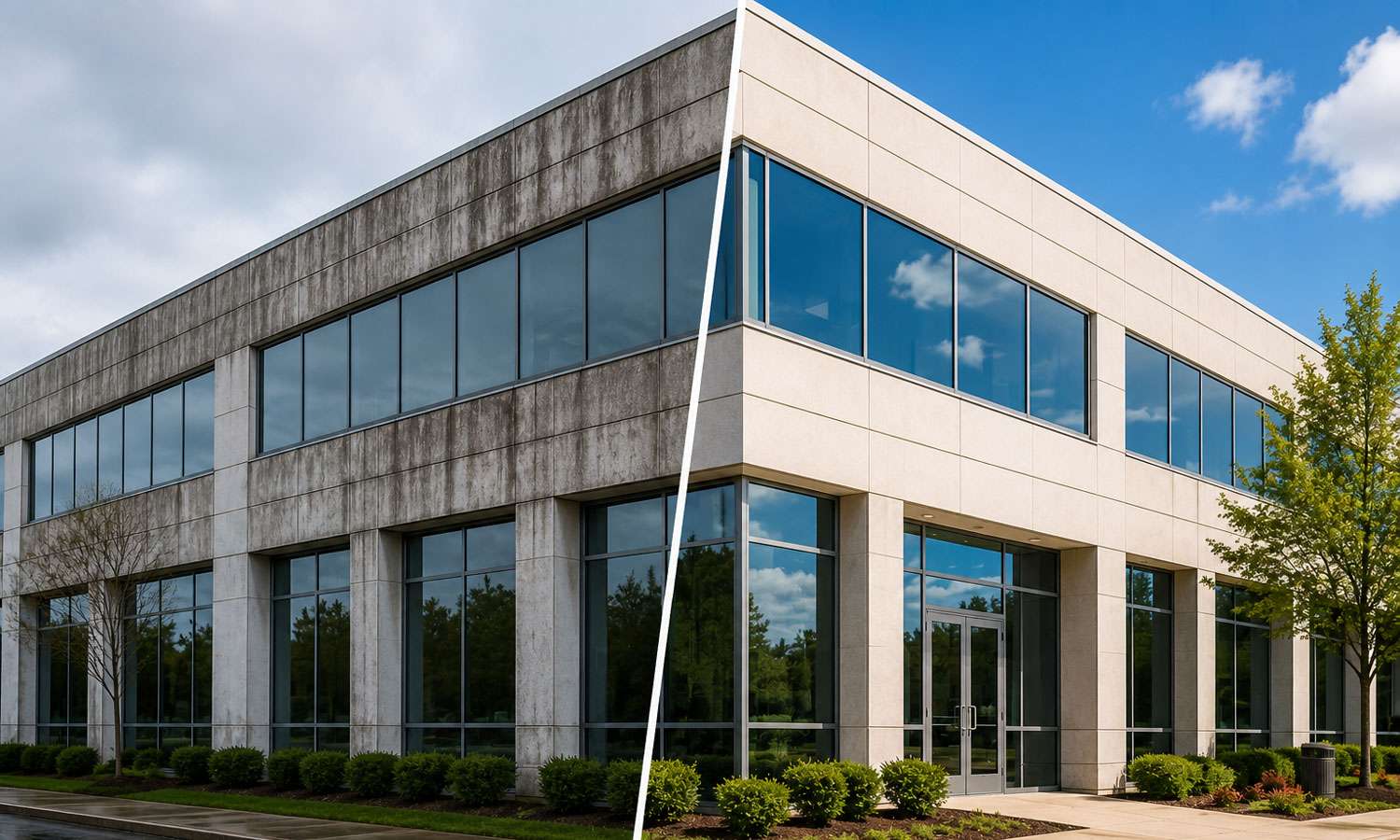
Skipping an exterior cleaning cycle can seem like an easy way to reduce a commercial property’s maintenance expenses.
The windows can wait another few months. The staining isn’t that noticeable yet. The façade still looks acceptable from the parking lot. The parking structure can make it through another season.
But deferred cleaning doesn’t always remain a cleaning issue.
Contaminants continue to accumulate. Staining can become more difficult to remove. Exterior surfaces continue to weather. And conditions that were once manageable through routine commercial building exterior maintenance may eventually require restoration, repair, or—in some cases—replacement.
The progression can look something like this:
Cleaning → Restoration → Repair → Replacement
Not every maintenance issue will follow that path. But identifying and addressing exterior conditions earlier generally gives property managers more options.
The Difference Between Cleaning and Restoration
Routine exterior cleaning is intended to remove normal dirt, debris, and environmental buildup before it becomes heavily established.
Restoration addresses conditions that routine cleaning can no longer adequately correct.
That distinction matters.
Consider commercial glass.
Routine window cleaning may remove dust, dirt, pollen, fingerprints, and other common contaminants. But mineral deposits, hard water staining, oxidation runoff, construction debris, and other substances can become increasingly difficult to remove over time.
Eventually, traditional window cleaning may no longer produce the desired result.
At that point, the question changes from:
“When should we clean the windows?”
to:
“Can this glass be restored?”
Restoration is a more specialized process—and typically a more significant maintenance project than routine cleaning.
1. Glass: When Window Cleaning Becomes Glass Restoration
Exterior glass is continually exposed to the environment.
Rainwater, irrigation overspray, minerals, pollution, metal runoff, construction residue, and other contaminants can leave deposits on the surface.
Initially, some of this buildup may appear to be ordinary dirt.
Over time, however, certain deposits can bond more aggressively to the glass or contribute to visible surface deterioration.
Signs Commercial Glass May Need More Than Routine Cleaning
Property managers should watch for:
- Cloudy or hazy areas that remain after cleaning
- White mineral deposits
- Hard water staining
- Rust-colored or oxidation runoff
- Etching or surface damage
- Repeated staining beneath façade components
- Uneven appearance across glass elevations
When these conditions appear, professional commercial glass restoration may be able to improve the glass without immediately resorting to replacement.
That makes early evaluation particularly important.
Replacing architectural glass can be significantly more disruptive than maintaining or restoring existing surfaces.
2. Metal: Oxidation Doesn’t Look Like Ordinary Dirt
Metal is another exterior material where cleaning and restoration are very different services.
Architectural metal, window frames, mullions, panels, and other components can lose their original appearance as they weather.
Oxidation may cause metal surfaces to appear:
- Chalky
- Faded
- Streaked
- Discolored
- Uneven
- Dull
At first glance, these surfaces may simply look dirty.
Routine washing, however, doesn’t necessarily correct oxidation.
Depending on the material and its condition, metal restoration may be appropriate to improve the appearance of weathered architectural metal.
The earlier the condition is identified, the sooner property teams can determine whether the surface needs cleaning, restoration, specialized evaluation, or another solution.
3. Concrete Staining Can Become Harder to Address Over Time
Concrete is durable, but its porous surface can collect and absorb contaminants.
Commercial sidewalks, parking structures, plazas, loading areas, and exterior concrete surfaces may be exposed to:
- Oil and vehicle fluids
- Tire residue
- Rust
- Dirt
- Organic growth
- Food and beverage spills
- Pollution
- Deicing materials
- Seasonal debris
Some staining can be addressed through routine commercial pressure washing or appropriate surface cleaning.
Other stains become increasingly difficult to improve after remaining on the surface for extended periods.
This is particularly relevant in parking garages and other high-traffic areas where new contaminants are constantly being introduced.
Regular cleaning helps prevent layers of buildup from accumulating season after season and gives property teams a clearer view of the condition of the concrete underneath.
4. Water Intrusion Is Not a Cleaning Problem—but Cleaning Can Reveal Warning Signs
Water intrusion requires an important distinction.
Cleaning does not repair a failed building envelope.
If water is entering a commercial building through deteriorated sealants, damaged façade components, failed flashing, cracks, or other defects, the underlying cause needs to be evaluated and corrected by the appropriate qualified professional.
However, routine exterior maintenance can help make some warning signs easier to see.
Heavy dirt, biological growth, staining, and other buildup can obscure exterior surfaces.
Once those contaminants are removed, property teams may be better able to observe:
- Deteriorating sealants
- Cracks
- Recurring water stains
- Damaged exterior materials
- Unusual runoff patterns
- Areas of persistent moisture
- Changes in façade condition
Commercial exterior maintenance therefore shouldn’t be treated as a substitute for building-envelope inspection.
Instead, it can be part of a broader preventative maintenance strategy that helps keep exterior surfaces visible and regularly observed.
5. Façade Deterioration Can Hide Behind “It’s Just Dirty”
Building façades accumulate environmental contaminants gradually.
Because the change happens slowly, it’s easy to become accustomed to the appearance of a property.
A little staining becomes normal.
Then more staining appears.
Pollution darkens certain areas. Organic growth develops in shaded locations. Rust or oxidation runoff appears beneath metal components. Water leaves repeated streaks along the same path.
Eventually, it becomes difficult to distinguish between a dirty surface and a deteriorating one.
That’s one reason commercial façade cleaning can be valuable beyond appearance.
Removing accumulated contaminants allows the underlying exterior surfaces to be seen more clearly.
If staining returns quickly after cleaning, or if unusual conditions remain, property teams have better information to determine whether further evaluation is warranted.
Cleaning, Restoration, Repair or Replacement?
When evaluating an exterior surface, it helps to think of maintenance as a progression.
Cleaning
Routine cleaning addresses normal dirt and environmental buildup.
Examples include:
- Commercial window cleaning
- Pressure washing
- Soft washing
- Parking garage cleaning
- Façade cleaning
Restoration
Restoration becomes appropriate when routine cleaning alone cannot adequately address the condition but the existing material may still be recoverable.
Examples may include:
- Glass restoration
- Hard water stain removal
- Mineral deposit removal
- Metal restoration
- Oxidation removal or treatment
Repair
Repair addresses a defect or failure in the building or material rather than surface contamination.
Examples might involve damaged components, failed sealants, cracks, leaks, or other building-envelope concerns.
These conditions should be handled by professionals qualified for the specific repair.
Replacement
When materials have deteriorated beyond practical restoration or repair, replacement may become necessary.
From a maintenance perspective, the objective is simple:
Identify conditions while you still have options.
The Hidden Cost of Deferred Exterior Maintenance
The immediate financial benefit of postponing maintenance is easy to calculate.
You didn’t spend the money this month.
The long-term cost is harder to see.
Deferred exterior maintenance may contribute to:
- More difficult cleaning later
- Specialized restoration needs
- Increasingly visible staining
- Reduced curb appeal
- Tenant or customer complaints
- More extensive future projects
- Less predictable maintenance budgets
- Shorter windows for scheduling work
This doesn’t mean every skipped cleaning leads to expensive repairs.
It means postponing routine maintenance removes an opportunity to manage exterior conditions proactively.
Preventative Maintenance Helps Property Managers Stay Ahead
A preventative exterior maintenance program creates regular opportunities to clean, observe, document, and evaluate building surfaces.
Instead of waiting until something looks significantly wrong, property managers can establish recurring maintenance intervals based on the property’s actual needs.
Those needs may vary depending on:
- Building materials
- Property location
- Environmental exposure
- Traffic
- Irrigation
- Nearby construction
- Tenant expectations
- Seasonal weather
- Previous maintenance history
A downtown high-rise may have very different exterior maintenance needs than a suburban office campus.
A parking garage exposed to winter road salt may require a different cleaning schedule than a structure in a warmer climate.
A property near irrigation systems may experience more frequent mineral deposits on glass.
There is no universal schedule.
The important thing is to have a schedule.
Look for Patterns, Not Just Problems
One of the most useful things a property manager can do is document recurring exterior conditions.
If the same glass develops hard water staining every year, determine what’s causing it.
If oxidation runoff repeatedly stains the same façade area, document it.
If water always collects near the same entrance, investigate the drainage pattern.
If one section of the building consistently develops biological growth, monitor it.
Patterns provide information.
And information makes it easier to decide whether a property needs routine cleaning, restoration, repair, or specialized evaluation.
Build Exterior Maintenance Into the Property Budget
Routine exterior maintenance is easier to manage when it is part of the annual plan rather than an unexpected expense.
Property teams can establish recurring schedules for services such as:
- Commercial window cleaning
- Pressure washing
- Soft washing
- Building washing
- Façade cleaning
- Parking garage cleaning
- Gutter and drainage cleaning
- Roof anchor inspections
Restoration needs can then be identified and budgeted separately when conditions warrant.
For multi-property portfolios, this approach also makes it easier to prioritize projects across locations and avoid multiple deferred maintenance needs arriving at once.
Supporting Commercial Properties Nationwide
S&K Building Services provides professional exterior building maintenance services across a growing network of markets throughout the United States.
From individual commercial properties to multi-location portfolios, we help property and facility management teams maintain exterior surfaces and develop more proactive maintenance strategies.
Our service areas include:
- Atlanta, GA
- Chicago, IL
- Cincinnati, OH
- Cleveland, OH
- Denver, CO
- Detroit, MI
- Finger Lakes, NY
- Grand Rapids, MI
- Indianapolis, IN
- Lansing, MI
- Louisville, KY
- Madison, WI
- Milwaukee, WI
- Nashville, TN
- New Orleans, LA
- Phoenix, AZ
- Portsmouth, OH
- Rochester, NY
- St. Louis, MO
- West Palm Beach, FL
With local teams operating throughout these regions, S&K Building Services supports both individual properties and multi-location portfolios with professional exterior cleaning, restoration, and maintenance solutions.
Protect Your Building Before Repairs Become Replacement
Deferred cleaning rarely stays just a cleaning issue forever.
The longer exterior conditions go unaddressed, the fewer maintenance options property teams may have.
Routine cleaning may become restoration. Developing conditions may require repair. And materials that can no longer be effectively restored or repaired may eventually need replacement.
The goal of preventative exterior maintenance isn’t to eliminate every future repair.
It’s to identify conditions early, maintain surfaces appropriately, and give property managers more options before problems become more extensive.
S&K Building Services provides commercial window cleaning, high-rise window cleaning, pressure washing, soft washing, façade cleaning, parking garage cleaning, glass and metal restoration, roof anchor inspection and installation, and specialty exterior maintenance services across the United States.
Protect your building before repairs become replacement.
Protect Your Building Before Problems Grow
Don’t wait until routine maintenance becomes restoration, repair, or replacement. S&K Building Services can help you stay ahead of exterior maintenance needs.
- Commercial exterior cleaning
- Glass & metal restoration
- Professional W-2 crews
- Multi-location portfolio support
Tell us about your property to get started.
Frequently Asked Questions About Commercial Building Exterior Maintenance
Commercial building exterior maintenance includes routine cleaning, inspection, and maintenance of exterior surfaces and systems. Depending on the property, this may include window cleaning, pressure washing, soft washing, façade cleaning, parking garage cleaning, glass and metal restoration, drainage maintenance, and roof anchor inspections.
Commercial glass cleaning removes normal dirt and surface buildup. Glass restoration addresses more difficult conditions such as hard water deposits, mineral staining, oxidation runoff, or other contaminants that routine cleaning may not remove. The appropriate service depends on the condition of the glass.
Mineral deposits can become increasingly difficult to remove when they remain on glass for extended periods, and some conditions may contribute to etching or other surface damage. Early evaluation can help determine whether routine cleaning or specialized glass restoration is appropriate.
Exposure to weather, UV radiation, moisture, pollution, and age can contribute to changes in the appearance of architectural metal. Oxidized surfaces may look chalky, faded, dull, streaked, or uneven and may require a restoration process rather than routine cleaning.
Pressure washing can remove many types of dirt and surface buildup from commercial concrete, but results depend on the contaminant, surface condition, how long the stain has been present, and the appropriate cleaning method. Some stains may require specialized treatment.
No. Exterior cleaning does not repair building-envelope failures or prevent water intrusion caused by defective materials or components. However, removing buildup can make exterior surfaces easier to observe and may help property teams identify visible conditions that warrant further professional evaluation.
Cleaning frequency depends on building materials, property type, environmental exposure, location, appearance standards, traffic, and previous maintenance history. A planned exterior maintenance schedule should be developed around the needs of the individual property rather than a universal cleaning interval.
Restoration should be considered when routine cleaning no longer produces an acceptable result or when surfaces show conditions such as significant mineral deposits, hard water staining, oxidation, or other persistent discoloration. A professional evaluation can help determine whether restoration is appropriate.
Regular exterior cleaning can help protect building materials by removing dirt, mineral deposits, biological growth, pollution, and other contaminants before they become more difficult to address. While cleaning cannot prevent normal aging or correct existing material failures, a consistent maintenance program can help preserve exterior surfaces and identify developing concerns earlier.
Ready to Get Started?
S&K is ready to get to work for you! A member of our team is available to discuss your needs and deliver a timely estimate of services.
Contact Us